Military history is often defined by the tense, unvarnished moments captured away from the safety of high command. One such historic image captures Field Marshal Erwin Rommel, the commander of the German Afrika Korps, closely reviewing tactical maps with his staff officers inside a forward command tent during the North African Campaign of World War II.
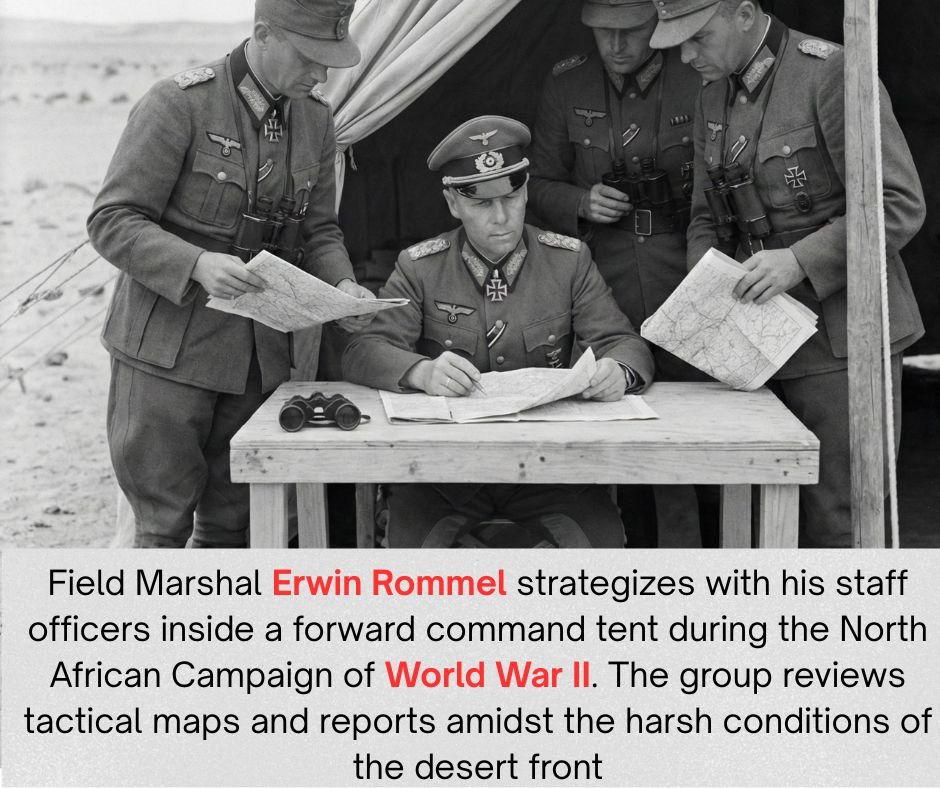
This photograph offers an authentic glimpse into the stark realities of desert warfare—a theater where lines on a map shifted like the sand dunes themselves. To understand the profound significance of this moment, we must examine the historical realities of Rommel’s operational doctrine, the tactical challenges of the North African theater, and the definitive timeline of the campaign.
The Birth of the Afrika Korps and the Desert Theater
Germany’s Intervention in North Africa
The North African Campaign took a critical turn in early 1941. Following the devastating collapse of Italian forces during the British offensive known as Operation Compass, Adolf Hitler formed the Deutsches Afrika Korps (DAK). In February 1941, then-Generalleutnant Erwin Rommel was dispatched to Tripoli, Libya, to assume command and prevent a total Axis collapse in the region.
The Origins of the “Desert Fox”
Rommel rapidly earned the moniker Wüstenfuchs (the Desert Fox) from both his allies and his British adversaries. The nickname was not merely propaganda; it was a direct reflection of his unpredictable, lightning-fast tactical improvisations. Rommel rejected the conventional military doctrine of commanding from a secure, distant rear headquarters. Instead, he consistently positioned his mobile command group (Gefechtsstand) at the absolute front lines, allowing him to exploit tactical openings in real time.
Deconstructing the Forward Command Tent Image
Mobile Warfare and the Power of the Map
The photograph vividly illustrates Rommel’s hands-on leadership style. Seated at a rudimentary wooden field table with a pencil in hand, Rommel anchors a group of specialized staff officers. In North Africa, warfare was purely mechanized and fluid, often compared by historians to naval battles at sea due to the lack of fixed natural obstacles.
Because landmarks were virtually non-existent in the deep desert, hyper-accurate cartography and rapid recalculations were matters of survival. The maps spread across the table and held by his officers were the lifeline of the Afrika Korps, dictating precise coordinates for tank maneuvers, flanking routes, and vital supply drops.
The Harsh Material Reality of Desert Combat
A closer look at the officers reveals the brutal environmental conditions of the theater. The dust-streaked uniforms, the heavy binoculars (Dienstglas) slung around their necks, and the simple canvas tent fabric underscore the absence of luxury. The North African front was characterized by extreme logistical hardships:
- Temperature Swings: Scorching daytime heat frequently exceeded 40°C (104°F), followed by near-freezing temperatures at night.
- The Khamsin: Choking sandstorms regularly blinded troops, jammed mechanical components, and grounded reconnaissance aircraft.
- Resource Deprivation: Severe shortages of water, clean rations, and medicine plagued both Axis and Allied troops, turning the campaign into a battle against the landscape itself.
The Operational Zenith and Ultimate Collapse
From Tobruk to the Gates of Egypt
Rommel’s forward-command methodology yielded stunning tactical victories. His greatest operational triumph occurred in June 1942, when his forces captured the heavily fortified British port of Tobruk, Libya. This victory resulted in the capture of over 30,000 Allied soldiers and vast quantities of fuel and supplies. Following this success, Rommel was promoted to the rank of Generalfeldmarschall (Field Marshal) and pushed his forces deep into Egypt, aiming for the Suez Canal.
The Turning Point at El Alamein
The aggressive strategy of leading from the front ultimately met its limits due to a collapsing supply chain. By late 1942, Allied naval and air supremacy in the Mediterranean severely choked the fuel and ammunition supplies destined for the Afrika Korps.
In October and November 1942, General Bernard Montgomery’s British Eighth Army launched a massive counter-offensive at the Second Battle of El Alamein. Facing overwhelming numbers and critically depleted fuel reserves, Rommel’s forces were forced into a definitive, long-distance retreat across Libya and into Tunisia, leading to the eventual Axis surrender in North Africa in May 1943.
The Historical Legacy of the Photo
This authentic photograph remains a foundational historical document of World War II. It strips away the mythos to reveal the functional reality of mid-century tactical planning. It captures Rommel not as a distant political symbol, but as a intensely focused operational commander executing a highly complex, high-stakes campaign amid the unforgiving terrain of the North African desert.